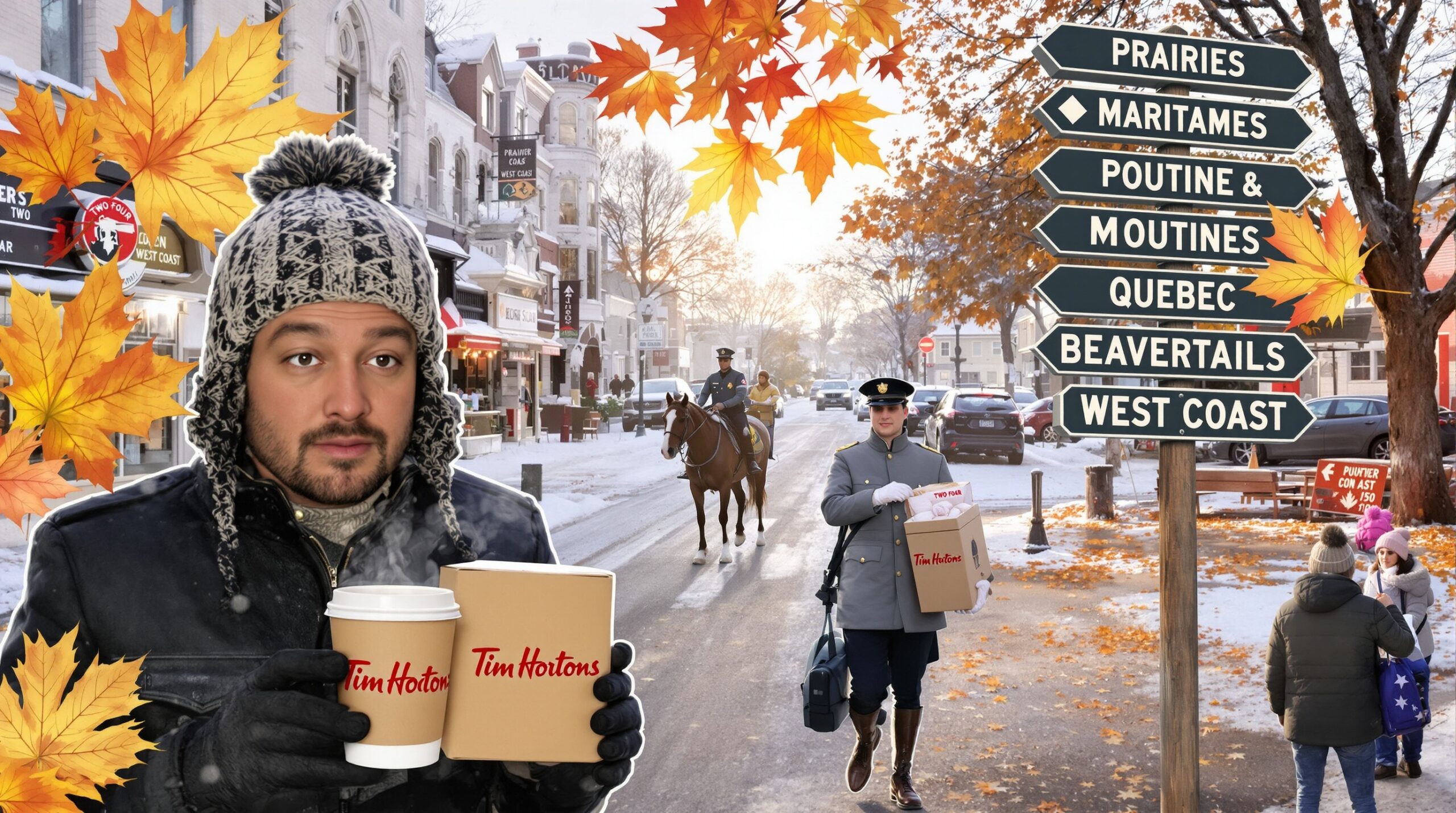
25 Canadian Phrases That’ll Make You Sound Like a Local (and Why They’re So Delightfully Canadian)
Canadians have earned a reputation for friendliness, politeness, and a colourful, practical vocabulary. Whether you want to fit in on a road trip across the provinces or just understand the banter in a Canadian TV show, these 25 phrases will get you sounding local fast. Each entry includes pronunciation, meaning, an example sentence, and a quick note on origin or region.
- eh — (pronounced: /eɪ/)
- What it means: A tag question to invite agreement or soften a statement.
- Example: “Nice weather today, eh?”
-
Note: Perhaps the most iconic Canadianism. Used nationwide; tone carries intent.
-
toque / tuque — (TOOK)
- What it means: A knit winter hat.
- Example: “Don’t forget your toque, it’s freezing out.”
-
Note: Spelled both ways; common across Canada.
-
double-double — (DOO-bul DOO-bul)
- What it means: A coffee with two creams and two sugars (Tim Hortons slang).
- Example: “Can I get a medium double-double, please?”
-
Note: Tim Hortons made this phrase ubiquitous.
-
Timmies — (TIM-mees)
- What it means: Tim Hortons coffee shop.
- Example: “Meet me at Timmies for a break.”
-
Note: Everywhere in Canada; practically an institution.
-
loonie / toonie — (LOO-nee / TOO-nee)
- What it means: $1 coin (loonie), $2 coin (toonie).
- Example: “Throw in a loonie for the coffee.”
-
Note: Nicknames come from coin designs (loonie has a loon bird).
-
washroom — (WOSH-room)
- What it means: Bathroom or restroom.
- Example: “Where’s the washroom?”
-
Note: More common in Canada than ‘restroom’ or ‘bathroom’ in public places.
-
chesterfield — (CHESTER-feeld)
- What it means: An older term for sofa or couch.
- Example: “We put the chesterfield against the wall.”
-
Note: Older generations may still use this; regionally variable.
-
pop — (POP)
- What it means: Carbonated soft drink (soda).
- Example: “Want a pop with that?”
-
Note: Western and central Canada favor ‘pop’; some say ‘soda’ in big cities.
-
rinky-dink — (RINK-ee DINK)
- What it means: Small, cheap, or shoddy.
- Example: “That was a rinky-dink operation.”
-
Note: Informal, playful.
-
kerfuffle — (ker-FUH-ful)
- What it means: A fuss or commotion.
- Example: “There was a bit of a kerfuffle at the ticket line.”
- Note: Used in both Canada and the UK; conveys light chaos.
-
give’er — (GIV-ur)
- What it means: Go for it; put in a lot of effort or speed up.
- Example: “Just give’er on the final lap.”
- Note: Especially common in Atlantic Canada and the Prairies.
-
hang a Larry / hang a Roger — (hang a LAR-ee / ROD-ger)
- What it means: Make a left (Larry) or right (Roger) turn.
- Example: “Hang a Larry at the next light.”
- Note: Western and rural usage; colourful regional slang.
-
two-four — (TOO-for)
- What it means: Case of 24 beers.
- Example: “Grab a two-four for the long weekend.”
- Note: Common around Victoria Day and Canada Day.
-
beauty / beaut — (BYOO-tee / BYOOT)
- What it means: Fantastic, great; also used as an exclamation.
- Example: “That sunset was a beaut.”
- Note: Especially popular in Western Canada.
-
keener — (KEE-ner)
- What it means: Eager person, overachiever (sometimes teasing).
- Example: “She’s such a keener — she’s already finished her assignment.”
- Note: Used in schools and workplaces; affectionate or mildly teasing.
-
hoser — (HOH-zer)
- What it means: Friendly insult meaning someone a bit foolish or uncool.
- Example: “Don’t be a hoser, eh.”
- Note: Old comedy stereotype (Bob and Doug McKenzie); used jokingly.
-
Canuck — (kuh-NUK)
- What it means: Slang for Canadian (often affectionate).
- Example: “He’s a proud Canuck from Vancouver.”
- Note: Used in sports team names and casual speech.
-
Mountie — (MOWN-tee)
- What it means: Member of the Royal Canadian Mounted Police (RCMP).
- Example: “A Mountie was at the ceremony.”
- Note: Iconic national symbol.
-
poutine — (poo-TEEN)
- What it means: Fries topped with cheese curds and gravy.
- Example: “Let’s get poutine after the hockey game.”
- Note: Quebec origin; now a national comfort food.
-
Chinook — (CHI-nook)
- What it means: Warm, dry wind that can rapidly raise temperatures in the Prairies.
- Example: “The Chinook will melt the snow tomorrow.”
- Note: Specific to Alberta and nearby regions.
-
runners — (RUN-ers)
- What it means: Sneakers or running shoes.
- Example: “Bring your runners for the gym.”
- Note: Common in Ontario and other parts of Canada.
-
hydro — (HY-dro)
- What it means: Electricity (often referring to the power company).
- Example: “Hydro’s out in our area after the storm.”
- Note: From hydroelectric power; e.g., Ontario Hydro.
-
serviette — (ser-vee-ET)
- What it means: Napkin.
- Example: “Please pass a serviette.”
- Note: More common in Canada than the US; especially in Quebec-influenced areas.
-
poppy — (POP-ee)
- What it means: Remembrance poppy worn for Remembrance Day.
- Example: “He pinned on his poppy for the ceremony.”
- Note: Strong cultural and historical significance.
-
the beavertail — (BEE-vur-tail)
- What it means: A popular fried pastry snack (stretch of dough with toppings).
- Example: “Grab a cinnamon-sugar beavertail at the fair.”
- Note: A delicious treat with roots in Eastern Canada.
Regional notes
– Quebec: English there borrows French words (serviette, depanneur for convenience store) and unique local slang.
– Atlantic provinces: “give’er” and “the Maritimes” expressions are common; friendly directness.
– Prairies: “Chinook”, “hang a Larry”, and practical slang show up often.
– West Coast: “beaut” and outdoor-focused vocabulary; Vancouver influences.
Quick tips for sounding natural
– Use ‘eh’ sparingly and match the tone of the conversation.
– Many Canadianisms are friendly and informal — use them in casual contexts.
– When in doubt with regional terms, ask — Canadians love explaining local slang!
A tiny pronunciation cheat-sheet
– eh: like the vowel in ‘day’
– toque/tuque: rhymes with ‘spook’ but with a short ‘oo’ sound
– loonie/toonie: stress on the first syllable
Mini quiz (answers below)
1) What’s a double-double?
2) If someone asks for the washroom, what do they mean?
3) What does ‘two-four’ refer to?
Answers: 1) Coffee with two creams and two sugars. 2) The bathroom/restroom. 3) A case of 24 beers.
Enjoy trying these out — and don’t be surprised if a friendly stranger says “beaut” back at you. Canada’s linguistic charm is as warm and varied as its landscapes.